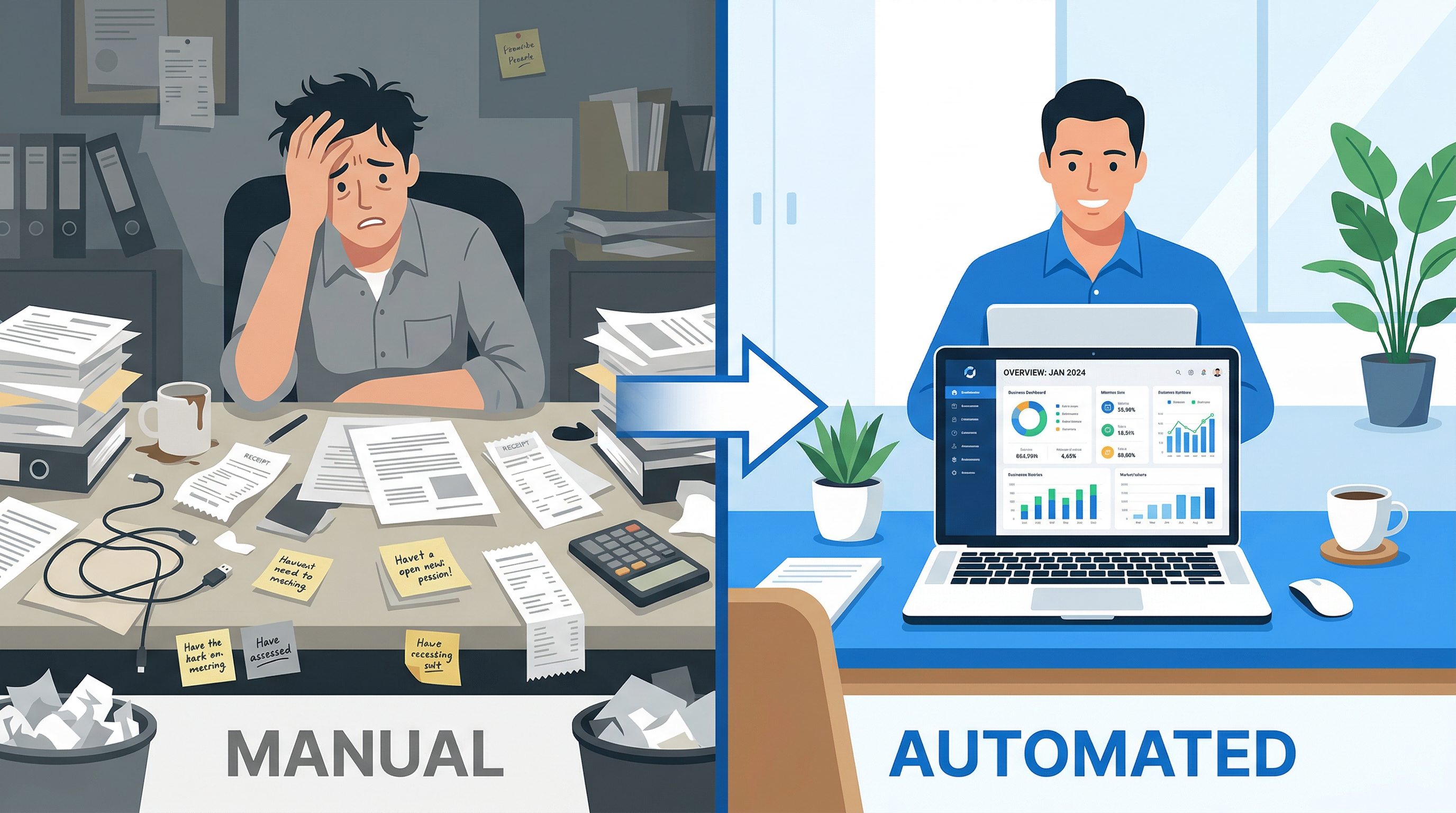
Most sole traders don't start their business to do admin. Automation gives you back the time to focus on the work that matters.
If you're a sole trader or running a small business in the UK, you already know the deal. You didn't start your business because you love chasing invoices, copying data between spreadsheets, or spending your Sunday evening doing admin you didn't get to during the week.
And yet, here we are. Research from Sage shows that UK small businesses lose an average of 24 working days a year to financial admin alone. Monzo found that over half of sole traders spend more than two hours every month just on tax-related tasks — time that adds up to 27 hours a year. That's more than three full working days spent on tax admin, never mind everything else.
The frustrating part? A lot of that work doesn't need a human. It needs a system.
"But automation is expensive, isn't it?"
This is the myth we hear most often. Business owners picture enterprise software with four-figure annual licences, or assume they need a full-time developer on the payroll. And yes, that world exists. But it's not the only option — and it's not how we work.
The reality in 2026 is that automation has two cost layers, and most people only think about one of them.
Layer 1: The infrastructure — often completely free. The major cloud platforms — Google, Microsoft, Amazon — all offer generous free tiers specifically designed for low-volume usage. The plumbing that moves your data around, watches for triggers, and runs on a schedule? For a sole trader or micro-business, that typically costs nothing at all.
Layer 2: The intelligence — pennies, not pounds. Where automation gets really powerful is when you add AI on top — drafting emails in your brand voice, categorising receipts, summarising sales data, generating content. This uses large language models, which do have a cost. But it's far less than people expect. A typical sole trader's AI usage comes in at a few pounds a month, not hundreds. We're talking pennies per task.
The trick is knowing how to put these two layers together — and that's where we come in. We recently built an automation pipeline for a Kent-based client that runs every 60 seconds, processes incoming data, formats and organises it, files it into their project management system, and sends them an email confirmation. The infrastructure cost? Zero. It sits comfortably within Google Cloud's free tier and has been running reliably for months.
The whole thing went from concept to working implementation in just a few days.
What does this actually look like in practice?
Let's make this concrete. Forget the jargon — here's what a simple automation actually does, step by step.
The problem: A business owner kept losing ideas, client requests, and to-do items across different apps, conversations, and notebooks. Things would come up during phone calls, in emails, or while out and about. By the time they sat down to act on them, half had been forgotten.
The solution: We built them a system that watches a single shared folder. Whenever anything lands in that folder — a note, a brief, a reminder — the system automatically picks it up within 60 seconds, formats it with the right tags and categories, files it into their organised project board, and sends a confirmation email so they know it worked.
The business owner can drop a note into that folder from their phone on a train, from their laptop at home, or by asking their AI assistant to save something. It doesn't matter how or where — every idea gets captured, categorised, and confirmed.
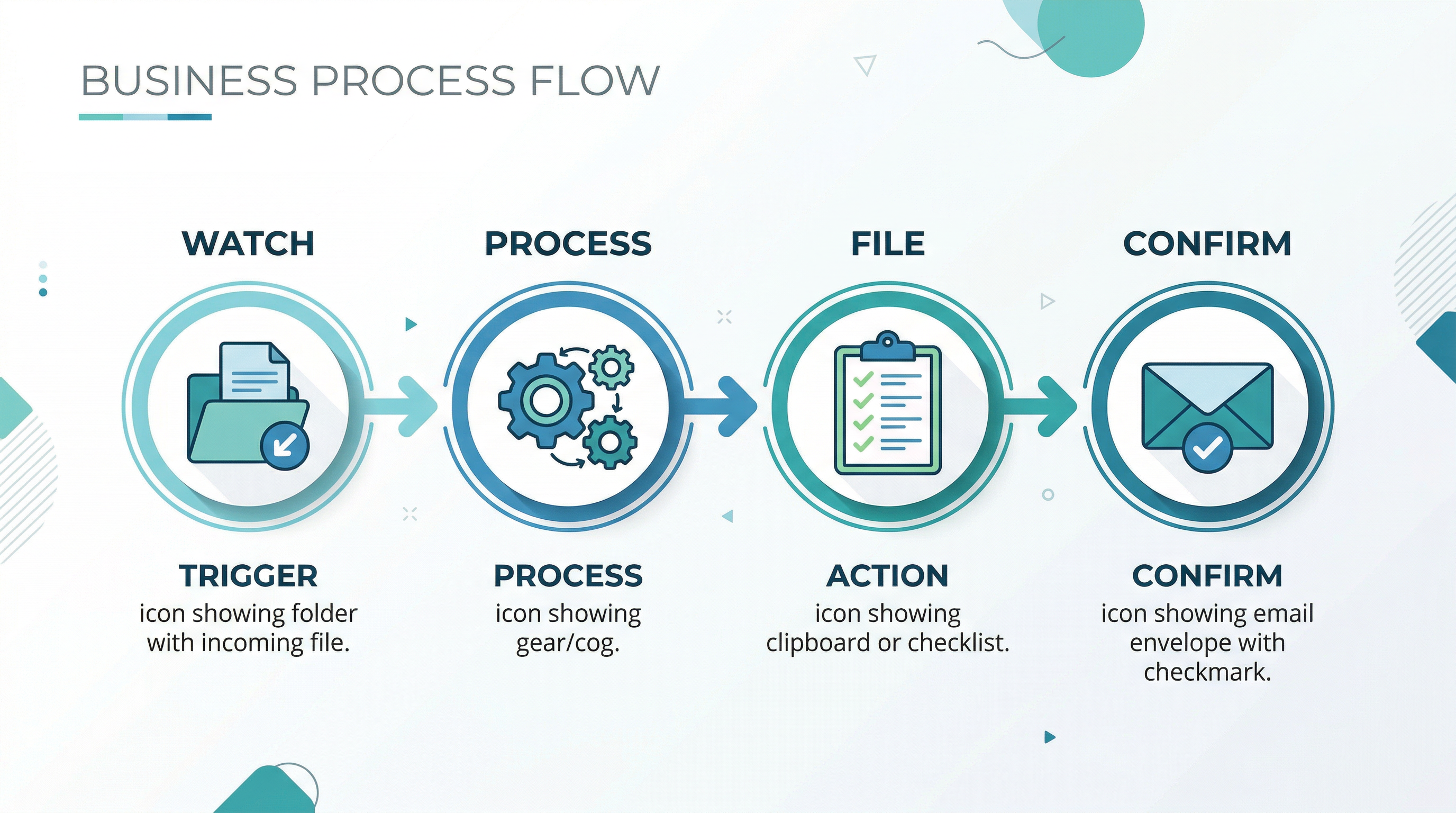
Every automation we build follows this pattern: watch for a trigger, process the data, file it where it belongs, confirm it worked.
The components:
- A Google Drive folder as the "inbox" (free)
- A Google Cloud Function that processes new files (free tier: 2 million invocations per month)
- A project management integration for organised storage (free tier)
- An email notification for confirmation (free)
- A scheduler that checks for new items every minute (free tier)
This particular pipeline is pure infrastructure — no AI needed — so the monthly running cost is genuinely £0. When you layer AI on top for smarter categorisation or natural-language processing, you're adding pennies per item, not pounds.
The pattern that makes this powerful
The specific example above is about capturing ideas and tasks. But the underlying pattern — "watch a trigger, do a thing" — applies to dozens of business processes. Once you see the pattern, opportunities are everywhere. The challenge is knowing which tools to connect, how to make them talk to each other, and how to make the whole thing reliable enough that you can forget about it.
That's the work we do for our clients. Here are five real applications of the same architecture that we've built for UK small businesses:
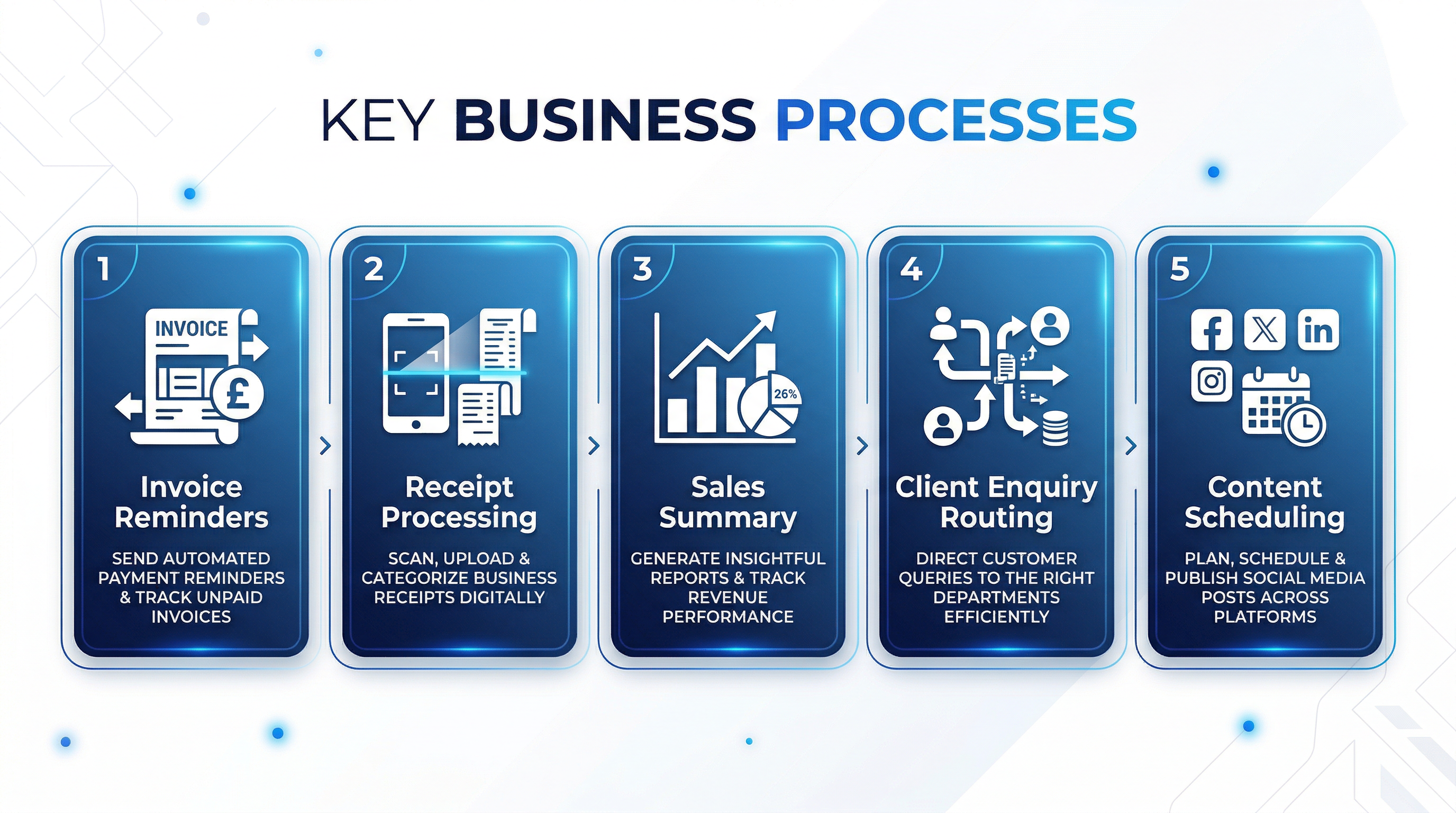
The same "watch, process, file, confirm" pattern powers all five of these common business automations.
Invoice reminder automation. Your accounting software flags overdue invoices. The automation picks them up, uses AI to generate a polite reminder in your brand voice, and sends it from your own email address. The customer has no idea it's automated — it just looks like you're impressively on top of your admin. Infrastructure: free. AI for natural-sounding emails: a few pence per message.
Receipt processing. Drop a photo of a receipt into a folder. The automation uses AI to extract the date, amount, and vendor, categorises it against your expense categories, and logs it to a spreadsheet or accounting tool. With Making Tax Digital now requiring quarterly digital submissions for sole traders earning over £50,000, this kind of automation moves from "nice to have" to "saves my sanity." Infrastructure: free. AI for extraction: roughly 1-2p per receipt.
Daily sales summary. If you sell on eBay, Amazon, Etsy, or any marketplace with an API, a scheduled automation can pull your previous day's sales every morning, calculate profit margins, and drop a summary into your inbox before you've finished your first coffee. One eCommerce reseller we work with has this running across four different marketplaces, summarising 650+ product lines into a single daily digest. This one is pure data processing — no AI needed, completely free to run.
Client enquiry routing. A simple form on your website drops submissions into a folder. The automation uses AI to categorise the enquiry (new project, support request, general question), drafts an appropriate acknowledgement, and flags urgent items for your immediate attention. Your response time drops from "when I next check my inbox" to under a minute.
Social media content scheduling. AI generates a batch of posts based on your business type, recent work, and seasonal events. The content drops into a review folder. You approve or tweak, then the automation handles scheduling and publishing. Your online presence stays active even during your busiest weeks.
Could a technically-minded person build some of this themselves? Possibly — if they had the time and knew which tools to connect. But most sole traders we talk to didn't go into business to learn cloud infrastructure. They want the result, not the project. That's why they come to us: we design, build, and maintain these systems so they just work, quietly, in the background.
The hidden benefit: insights you never had before
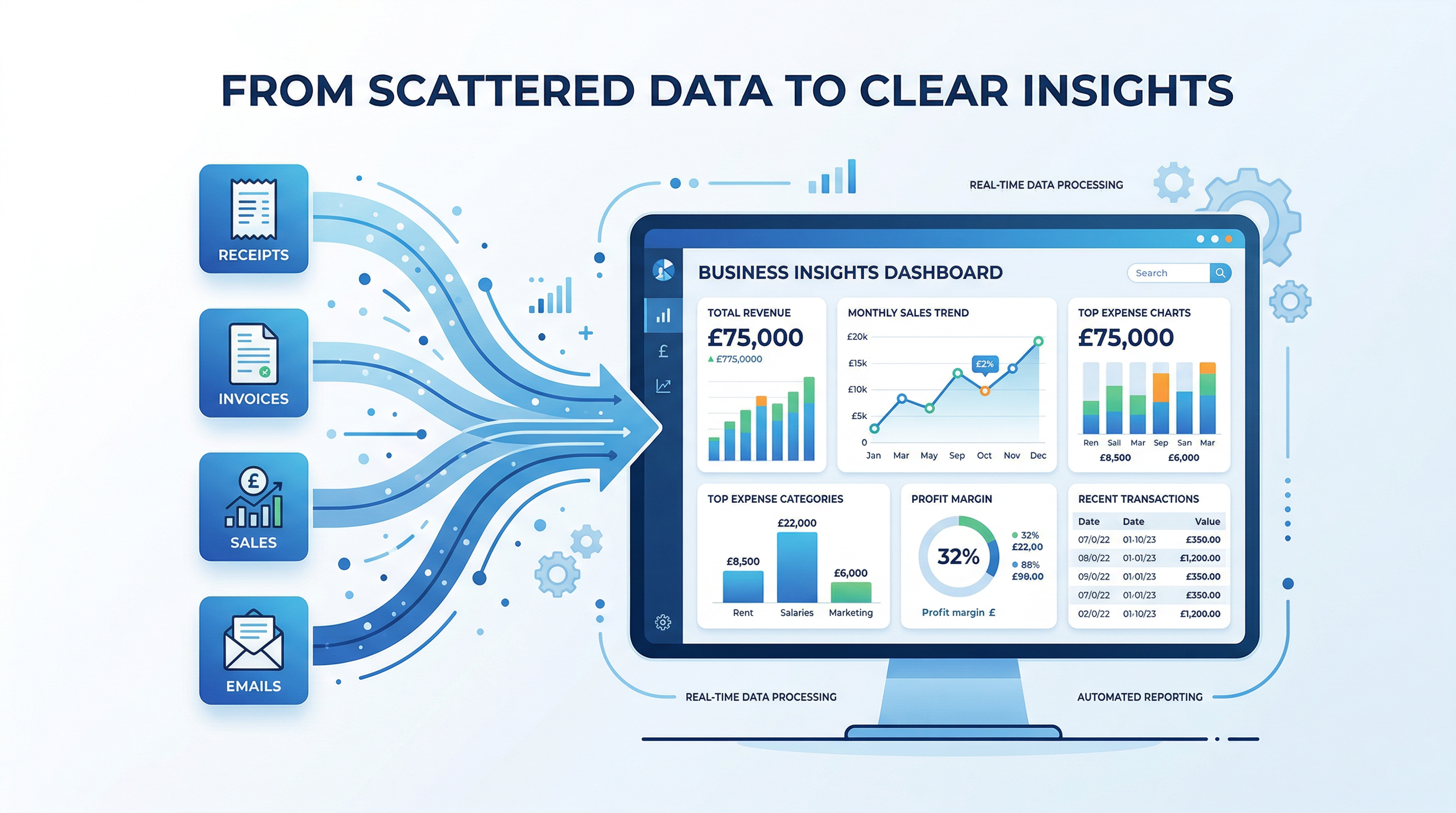
When receipts, invoices, sales, and emails all flow into one system, you get a clear picture of your business for the first time.
Here's something most people don't expect when they start automating. The time savings are obvious — that's why you do it. But the real shift happens when your data starts flowing through consistent, structured systems instead of being scattered across inboxes, spreadsheets, and sticky notes.
When every receipt is categorised the same way, every time, you can suddenly see where your money is actually going — not where you think it's going. When every sales transaction across every platform lands in one place, you can spot trends you'd never catch manually: which products sell faster at certain times of year, which marketplace gives you better margins, where your cash flow tightens.
One eCommerce client we work with went from manually checking four separate marketplace dashboards to receiving a single daily summary. Within the first month, they spotted that their best-selling product on one platform was significantly underpriced compared to another — something invisible when the data lived in separate silos. That one insight paid for a year's worth of automation in a single week.
This is the compounding effect of automation. It starts by saving you time. Then it starts saving you money. Then it starts making you money — because you're finally seeing your business clearly, with clean, consistent data that tells a real story.
We help our clients design systems with this in mind from the start. It's not just about automating a task — it's about building the foundation for better decisions down the line.
Why this matters more in 2026 than ever
Three things are converging that make automation particularly relevant for UK sole traders right now.
First, Making Tax Digital is here. From April 2026, sole traders earning over £50,000 must submit quarterly digital updates to HMRC through compatible software. That's four times a year instead of once. If your record-keeping is still manual, this is going to hurt. Automated receipt capture, expense categorisation, and transaction logging aren't luxuries anymore — they're the difference between a smooth quarterly submission and a panicked weekend of spreadsheet archaeology. We've helped several clients get their financial data flowing cleanly ahead of the deadline — the earlier you start, the less painful it is.
Second, AI has made automation dramatically more powerful. Two years ago, writing an automated email that sounded human required careful templating and testing. Today, AI can generate context-aware messages in your brand voice, categorise incoming data intelligently, and summarise complex information into plain English. The "brain" of an automation used to be the expensive part. Now it costs pennies per task — you just need someone who knows how to wire it up properly.
Third, the tools have matured, but the complexity hasn't gone away. Google Cloud Functions, Make.com, Zapier, n8n — the building blocks are better than ever. But choosing the right tool, connecting it to your existing systems, handling edge cases, and keeping everything running reliably? That still takes expertise. The platforms are more accessible, but "accessible" and "easy" aren't the same thing. That's exactly the gap we fill — we know these tools inside out, and we build systems that just work.
How to spot your biggest automation opportunities
If you're reading this and thinking "I could use some of that," here's how to start identifying where automation would make the biggest difference in your business.
Step 1: Write down the three tasks you do most often that feel repetitive. Chasing invoices? Copying data between tools? Posting on social media? Sending the same follow-up email? Be specific.
Step 2: For each task, ask yourself: "Does this require human judgment, or am I just following a process?" If you're following a process — the same steps, in the same order, triggered by the same event — it's a prime candidate for automation.
Step 3: Estimate the time. If a task takes you 20 minutes and you do it three times a week, that's an hour a week, or 52 hours a year. Over six working days. That calculation often surprises people.
Step 4: Bring that list to us. This is the part where most people get stuck. You know what needs automating, but not how. That's our job. We take your list of frustrations, map them to the right combination of free infrastructure and low-cost AI, build the system, test it, and hand it over — working and reliable. We also maintain and evolve it as your business grows, so you never have to think about it again.
The honest bit: what automation should and shouldn't replace
We'd be doing you a disservice if we pretended automation solves everything. It doesn't, and we'd never suggest it should.
Automation is excellent at repetitive, rule-based tasks: if X happens, do Y. It's brilliant at processing, categorising, and routing information. With AI on top, it's increasingly good at generating draft content, summarising data, and handling communication that used to require your personal attention.
But it's not a replacement for the thing your customers actually pay you for. The plumber who diagnoses a tricky leak, the designer who nails a brand identity, the consultant who asks the question nobody else thought of — that's human work, and it's where your time should be spent.
Our job is to protect that time. Every hour we claw back from your admin is an hour you can spend on the work that actually earns money and builds your reputation. We handle the systems; you handle the craft.
What this means for your bottom line
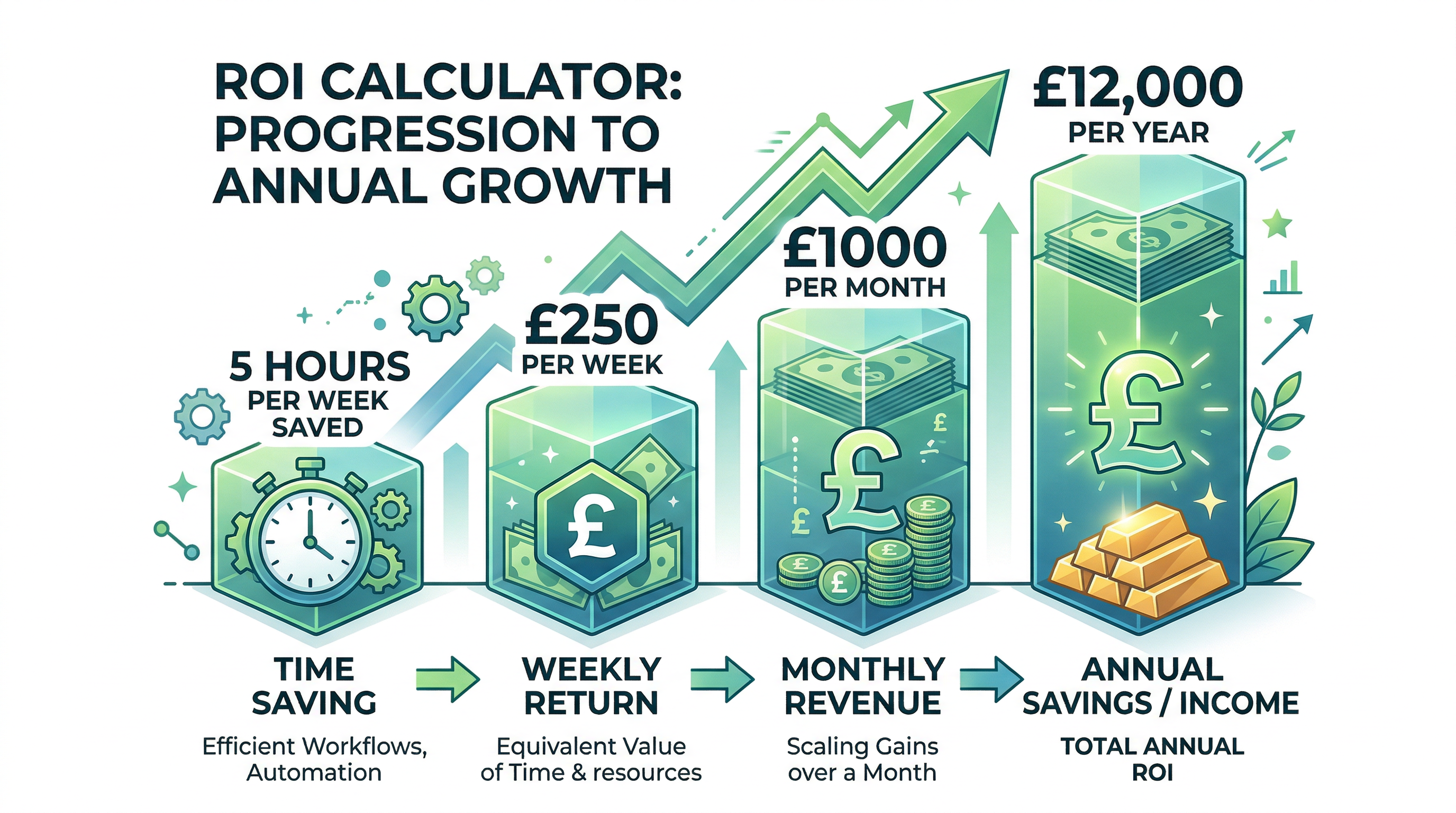
The maths is simple: 5 hours saved per week at £50/hour compounds to £12,000 per year.
Let's run the numbers on a simple example. Say you're a sole trader charging £50 an hour for your services. If automation saves you five hours a week of admin (which is conservative for most of the businesses we talk to), that's:
- £250 per week of time freed up
- £1,000 per month — either in additional billable hours or in simply getting your evenings back
- £12,000 per year — from systems that cost a few pounds a month to run
Factor in the infrastructure (free), the AI layer (a few pounds a month), and our service to build and maintain it all — and the return on investment is overwhelming. Even if you only convert half of that saved time into billable work, you're looking at £6,000 a year of additional revenue.
Then add the insights layer. When your data is clean and consistent, you make better decisions — you price more accurately, you spot opportunities faster, you stop leaving money on the table. That value is harder to put a number on, but our clients tell us it's where the real transformation happens.
Ready to find your quick wins?
Every business has processes that are quietly eating hours every week. The trick is knowing which ones to automate first, how to combine free infrastructure with low-cost AI, and how to build something that keeps running reliably without you babysitting it.
That's what we do. We offer a free 30-minute automation audit where we map your current workflows, identify the biggest time sinks, and show you exactly what could be automated — including a realistic breakdown of what it would cost (which is often far less than you'd expect). No sales pitch, no obligation. Just a clear picture of where you're losing time and how to get it back.
Request your free automation audit →